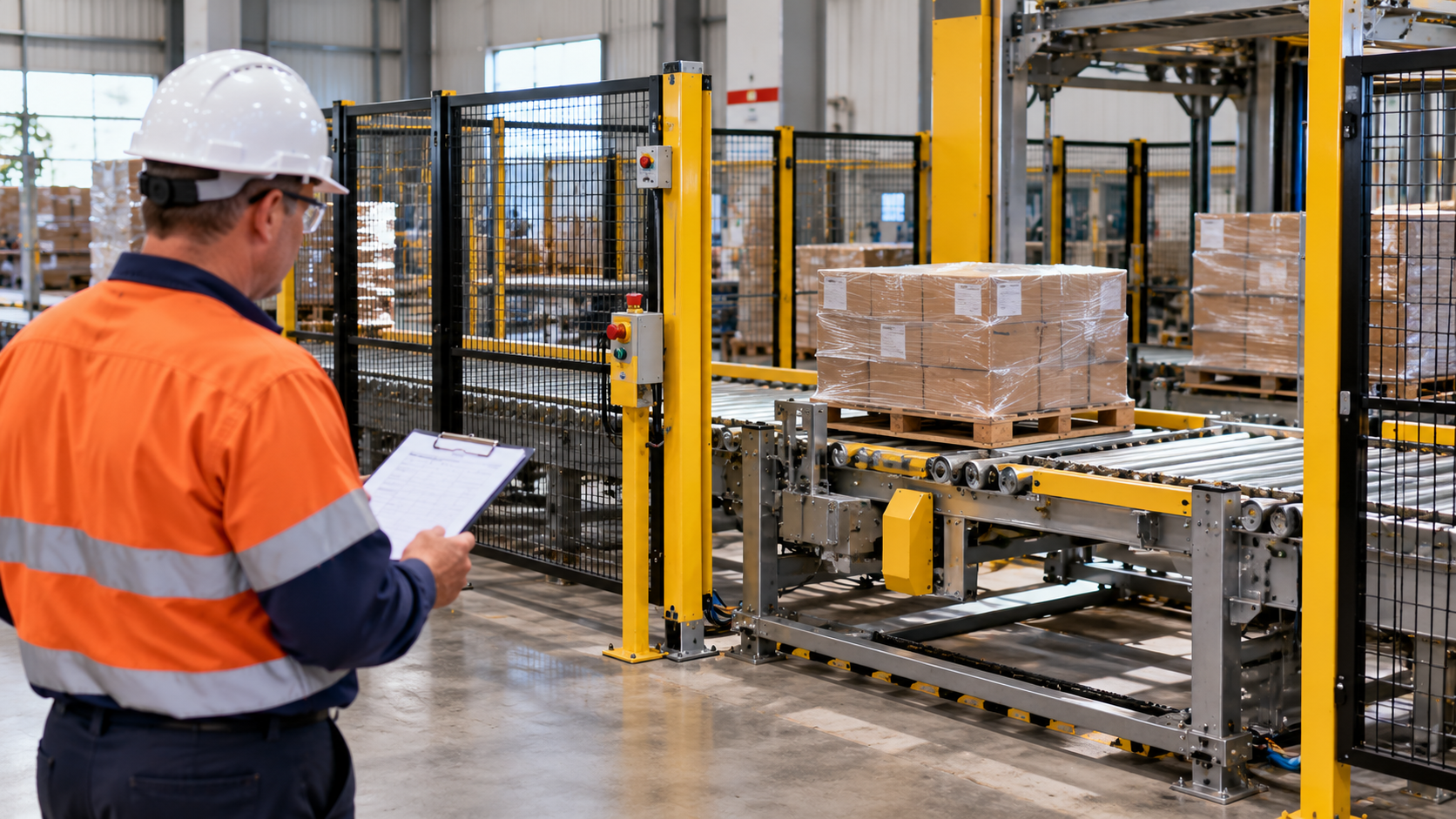
A worker was standing on a conveyor, using a crowbar to free a jammed pallet. When the pallet came loose, the conveyor’s automatic cycle restarted and crushed his ankle.
On 26 October 2026, the Industrial Court of NSW imposed an $807,500 fine for a category 2 work health and safety offence. The fine followed a 15% reduction from $950,000 for a guilty plea entered only weeks before a scheduled seven-day hearing. The company was also ordered to pay the prosecutor’s costs. Official sentencing judgment, [2026] NSWIC 63
This was a recurring problem
The pallet jams were not a one-off. The court heard that they had become frequent, and workers were dealing with them in different ways, including using the control panel, forklifts, manual handling and crowbars. There was no safe procedure telling workers how to clear a jam or requiring the conveyor’s energy sources to be isolated before anyone intervened.
The company’s own records had raised the issue before the injury. Earlier incident reports referred to crowbar use. A 2021 hazard report recorded that operators were getting onto the line and identified the need for a risk assessment and safe procedure. The court found that no such procedure was developed.
The worker had not been trained to isolate the conveyor and did not know it could resume its automatic cycle when an obstruction was cleared. The machine’s operating manual warned that it could start without warning and required full isolation before anyone went onto the conveyors. He had not been given that manual or the company’s internal lockout procedure.
The supervision gap mattered
At the time, the warehouse manager was on leave and nobody had been appointed to fill the role. The most senior employee at the site was a transport supervisor whose responsibilities concerned truck movements. He had no experience supervising the bag line and had not been trained in its operation.
That matters because a safe system depends on more than written instructions. Someone on site must understand the task, know what workers are doing when jams occur and be able to stop unsafe improvisation. Here, the court found the company had not provided adequate supervision, instruction, information or training for clearing pallet jams.
The conviction history changes the context
The court considered 13 previous work health and safety convictions recorded between 1999 and 2025 across several Australian states. They included failures to provide safe environments and safe systems of work, as well as incidents involving serious or fatal injuries.
The court referred to earlier cases involving a worker killed during wharf operations and a forklift incident with similarities to the Banksmeadow case. It concluded that the history could not be dismissed as an uncharacteristic aberration and found that the company had shown a continuing resistance to taking a proactive approach to eliminating or minimising safety risks.
Thirteen convictions over 26 years is a substantial history. It needs to be considered alongside the scale of the operation: the judgment records that the employer had approximately 4,950 operational employees across Australia. Its corporate group describes itself as part of Japan Post and as a major transport and logistics provider across the Asia-Pacific region. Scale does not excuse repeated safety failures. It does make the need for reliable systems, consistent oversight and learning across sites especially clear.
The court also considered evidence that the business held safety conversations with workers and had taken remedial steps after the incident. It accepted that the company showed genuine remorse by sentencing, although the weight given to that remorse was limited by its earlier attempt to characterise the worker’s actions as an unpredictable departure from an established safe system. The court found there was no established safe system for clearing these jams.
What managers should take from the decision
Recurring jams should trigger a review of the task, not just another workaround. Managers should make sure that:
- a safe method for clearing jams is written, practical and followed;
- workers know when and how to isolate the relevant energy sources;
- workers receive task-specific training, including on automatic restart;
- supervisors on every shift understand the plant and the work being done;
- incident reports and hazard reports lead to tracked actions and verified close-out; and
- similar incidents and corrective actions are shared across sites where the same equipment or tasks are used.
The judgment is a reminder that known hazards become more serious when reports identify them but the organisation does not turn them into effective controls. A procedure, training record or safety conversation only helps if it changes what happens when the jam occurs.
Source: Industrial Court of NSW sentencing judgment, [2026] NSWIC 63, 26 October 2026. The company and individuals are not named in this article.